
Flying High With DEX: How Southwest Transformed IT Into a Business Accelerator

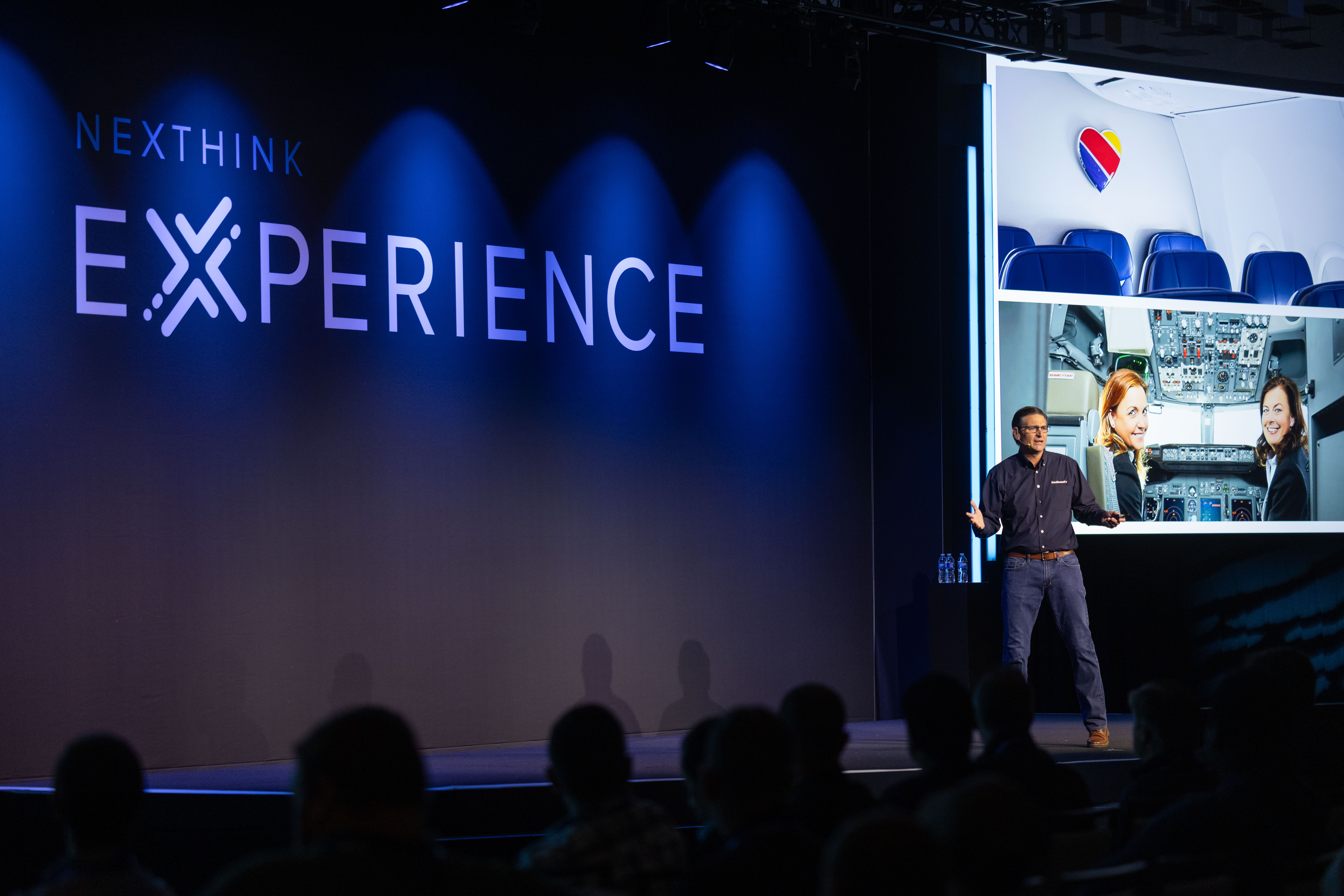
This article is based on a presentation given at Experience 2025 by Derek Whisenhunt, Head of End User Computing at Southwest Airlines.
Customer overview:
Industry: Aviation
Scale: Large global airline with mission-critical frontline operations
IT focus: End user computing, endpoint operations, employee productivity
DEX Outcomes:
1.4 Billion remote actions successfully deployed
24,000 man hours saved, representing a 50% increase in IT productivity
90 resources saved
The challenge: scaling innovation without disrupting the business
Southwest Airlines operates in one of the most demanding environments in the world. Reliability, safety, and efficiency are non-negotiable—not only for customers, but for the tens of thousands of employees who keep the airline running every day.
For years, Southwest’s end user computing teams faced a familiar enterprise challenge: technology issues were discovered only after they reached production scale. New changes worked in theory, but real problems surfaced only once thousands of endpoints were affected. Without true production-level visibility, the service desk became the default detection system.
This reactive model came at a cost:
- Endpoint issues identified through tickets instead of telemetry
- Highly skilled engineers pulled into repetitive firefighting
- Limited insight into which issues truly impacted productivity
- Growing pressure from the business to deliver faster, higher-quality innovation demanded better awareness of the impacts of change
At the same time, Southwest was entering the largest transformation in its history. Post-COVID shifts in customer behavior forced the airline to evolve its offerings—introducing premium seating, expanding digital channels, optimizing loyalty programs, rolling out free Wi-Fi, and forming new airline partnerships. All of this needed to happen quickly, reliably, and at scale.
The risk was clear: without a new IT operating model, innovation velocity and employee experience would collide.
A new perspective: treating digital experience like flight instrumentation
Southwest reframed its IT challenge using a principle deeply rooted in aviation.
When pilots lose visual references, they rely on instrument flight rules (IFR)—trusted, precise instrumentation that reduces risk and ensures stability. Southwest recognized IT needed the same capability: real-time, trustworthy insight into digital experience, rather than anecdotal feedback and ticket volume.
This marked a strategic shift:
- From ticket-driven response to experience-led operations
- From reactive troubleshooting to proactive risk reduction
- From guessing impact to measuring it
The Nexthink approach: visibility, governance, and automation at scale
Southwest adopted Nexthink to establish a governed Digital Employee Experience (DEX) operating model, anchored in three foundational principles.
1. A shared mission and clear governance
Southwest defined a single DEX mission: continuously enhance the digital employee experience so employees can work without disruption from technology issues—measured through DEX scores and direct feedback.
This alignment eliminated fragmented efforts and focused teams on outcomes that mattered to the business.
2. Automation first—without disrupting employees
Rather than increasing employee interactions, Southwest prioritized autonomous and invisible remediation. The majority of issues were addressed automatically, reserving employee-facing interactions for only the most critical moments.
3. Operational discipline at enterprise scale
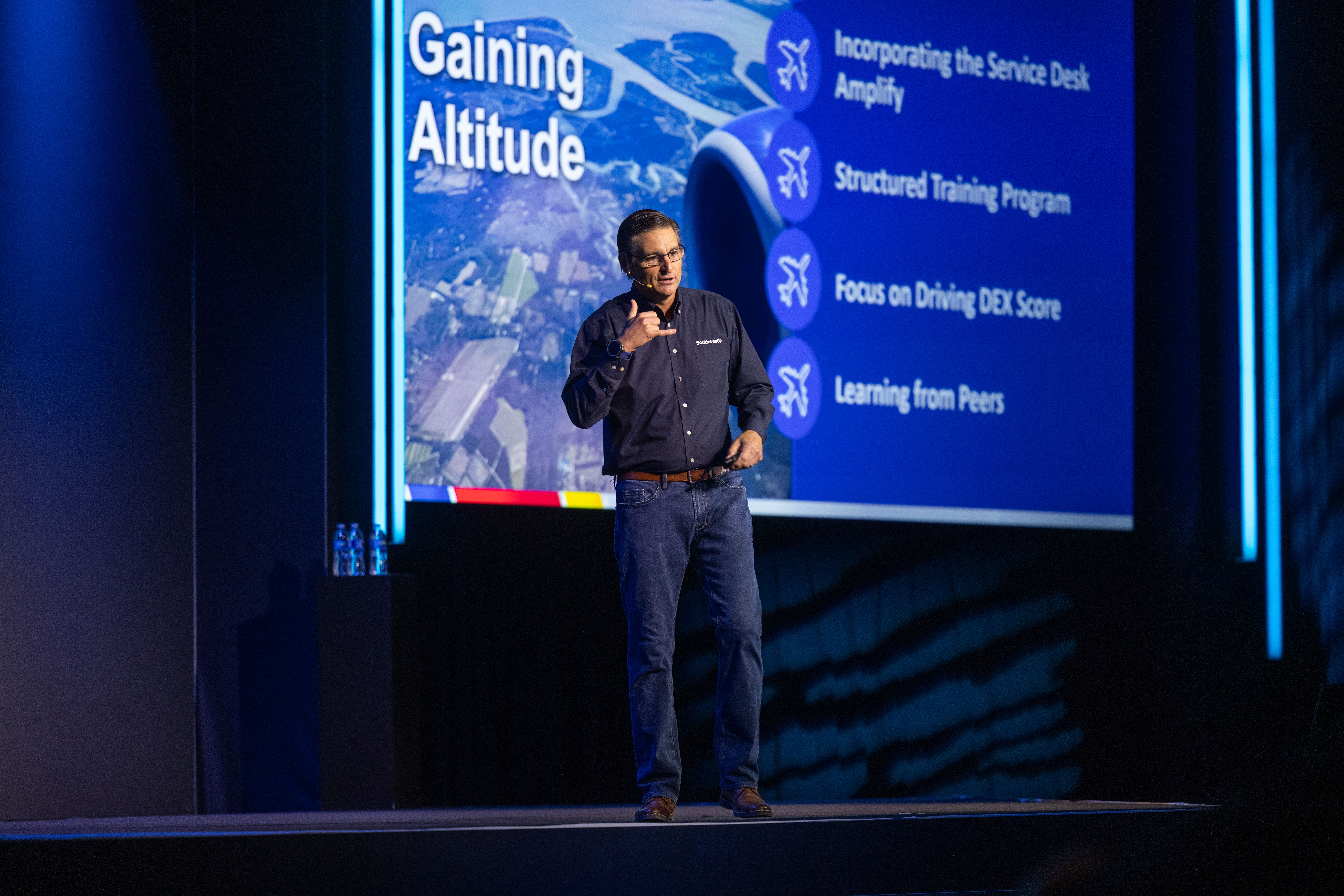
Dedicated DEX resources, clear separation between engineering and operations, structured training, and full service desk integration ensured Nexthink delivered sustained value—not short-term wins.
Business results: measurable impact at scale
50% improvement in IT productivity
By shifting from reactive firefighting to proactive, automated operations, Southwest improved IT productivity by 50%, powered by 1.4 billion Nexthink automations. Engineers reclaimed time to focus on innovation rather than repetitive fixes.
Faster, safer business transformation
Nexthink enabled IT to support multiple large-scale initiatives simultaneously—without sacrificing reliability. Projects that once took 18 months were delivered in months, while maintaining quality and stability.
Direct operational efficiency gains
One example: digitizing aircraft turn processes removed five minutes per turn, effectively freeing up the equivalent of 18 aircraft—without purchasing new planes. Digital experience improvements translated directly into business capacity and cost efficiency.
Improved employee experience
Endpoint issues were detected and resolved proactively, reducing disruption for frontline and corporate employees alike. Fewer interruptions meant employees could focus on delivering Southwest’s signature customer experience. This emphasis on DEX excellence has resulted in 24,000 man-hours saved for the business. That’s almost 3 full years of employee productivity returned to the business.
Strategic impact: from IT support to business enabler
With Nexthink, IT became a trusted partner in Southwest’s transformation:
- Digital experience evolved into a reliable operational signal
- Risk was reduced through instrumentation and automation
- IT shifted from a reactive cost center to a strategic business accelerator
Southwest laid a scalable foundation for Zero Tickets, where issues are prevented, resolved automatically, or eliminated entirely.
Why this matters
Southwest’s journey demonstrates that Digital Employee Experience is not an IT initiative—it is a business strategy. With the right visibility, governance, and automation, organizations can unlock productivity, reduce risk, and accelerate transformation across the enterprise.
To hear the full story, watch Southwest’s keynote presentation on stage at Experience Boston 2025.